Pinterest Offices

Caption
Year: 2013
Location: San Francisco
Client: Pinterest
First Office Team: Anna Neimark, Andrew Atwood, Benjamin Farnsworth, Austin Kaa, Steven Moody, Mark Acciari, Ewan Feng, Kate Hajash, Brian Lee, Darle Shinsato, Jane Zhu
Collaborator: Janette Kim, All of the Above
Executive Architect: Neal Schwartz, Schwarts and Architecture
Contractor: Novo Construction
MEP Engineer: McMillan Electric

Caption
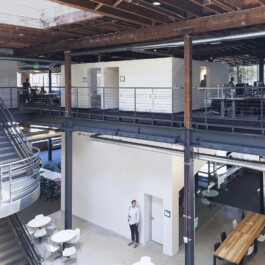
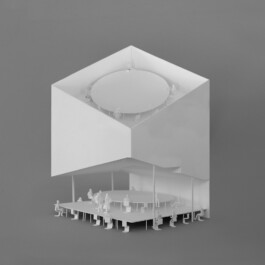
When we first met with Pinterest company executives in 2011 to discuss their intentions for their Palo Alto garage space, there were twelve people in the group, total. They were looking to expand and asked us to design an office environment that could handle continual growth. Our response was through monumentality. Rather than buying a desk for every new code writer, we proposed one large table that could accrue dense collaborations over time. It measured thirty-two feet by thirty-two feet and offered a maximum occupancy of sixty people.

Caption
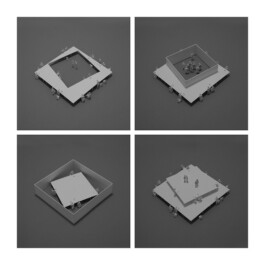
The table went into fabrication, when we were called in for a second meeting. The company had exploded. Pinterest had tripled in size, and the partners were looking to lease a new space, a 45,000-sf warehouse in San Francisco that could easily fit up hundreds of people. To our next meeting, we brought: sixteen tables, a plan, a model, and a quote – not a price quote, which we are sure they would have preferred – but a quote from the short formalist essay, “Art as Technique,” from 1917, by the literary theorist, Victor Shklovsky:

Caption
“And so life is reckoned as nothing. Habitualization devours works, clothes, furniture, one’s wife, and the fear of war. ‘If the whole complex lives of many people go unconsciously, then such lives are as if they had never been.’ The technique of art is to make objects ‘unfamiliar,’ to make forms difficult, to increase the difficulty and length of perception because the process of perception is an aesthetic end in itself and must be prolonged.”


Caption


Caption


Caption


Caption


Caption


Caption


Caption


Caption
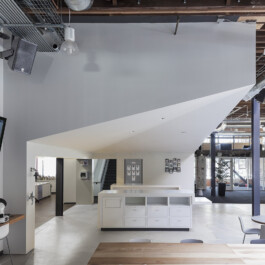
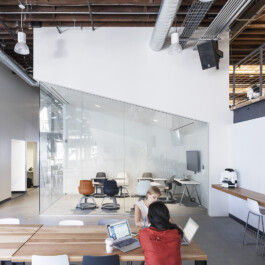
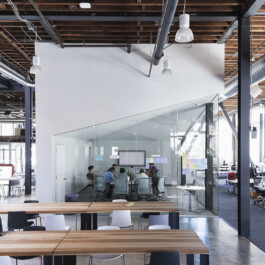
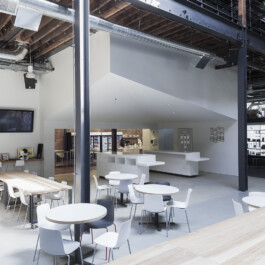
We argued that a creative office cannot function on efficiency, expediency, connectivity, and productivity alone, that to construct meaningful social interactions, we have to also produce difficult spaces that counter the habitual environment of the desk, the meeting room, the corner office. Tables would have to be shared, sometimes climbed over, under and upon; meeting rooms would be difficult to enter, then again also difficult to exit, forcing everyone into lock-down; offices would make hierarchies explicit, even around the most democratic, circular table. Difficulty of habitation inside the Pinterest Offices would produce distance between work and workflow, estranging the format of office interactions, proposing that social awkwardness could cut across social engineering.

Caption
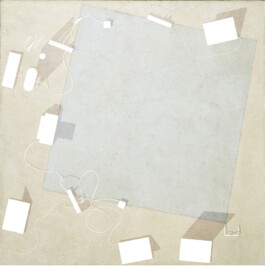
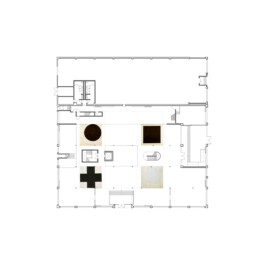
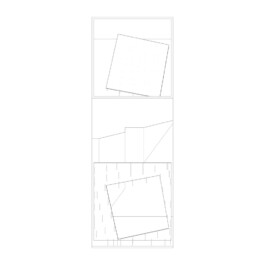
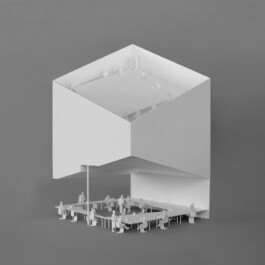
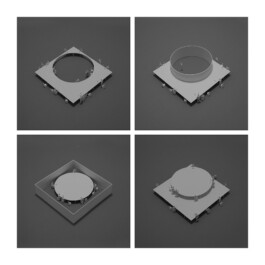
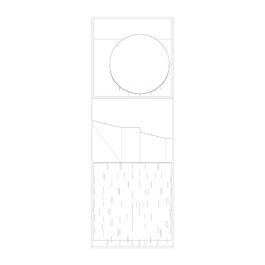
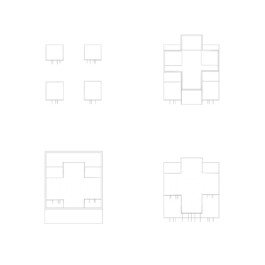
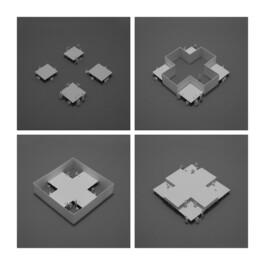
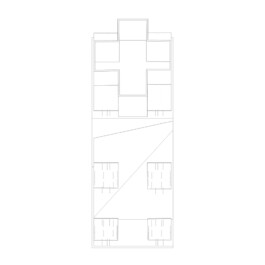
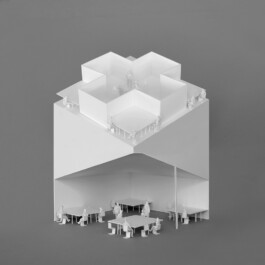
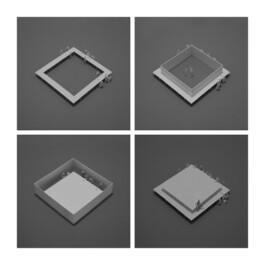
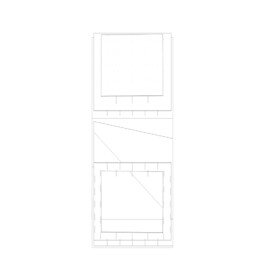
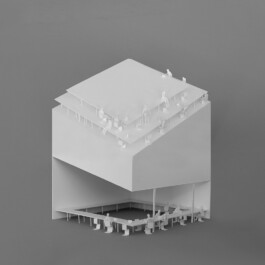
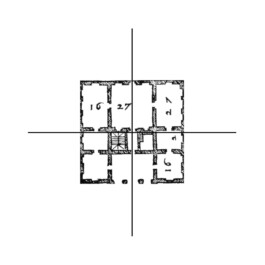
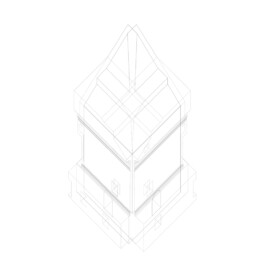
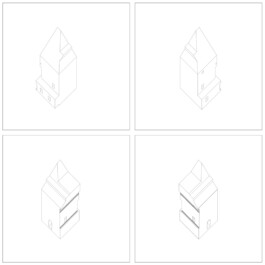
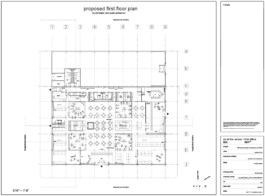
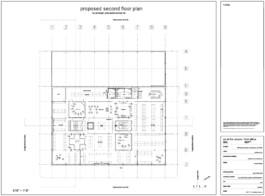
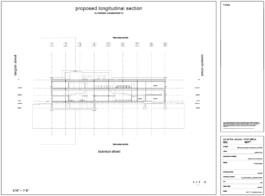
Our interior plan centers on four houses set within the raw infrastructural workspace of the historic warehouse. The monumental furniture pieces held within are based on early Suprematist paintings by Kazimir Malevich: Black Square (1915), Black Cross (1915), Black Circle (1915), and White on White (1918).

Caption


Caption


Caption


Caption


Caption


Caption

Caption
Site: Mr. Wren & Friends. Logo and La Grotesque typeface by Francesca Bolognini
First Office was founded in 2011 by Anna Neimark and Andrew Atwood to create a dialog between architectural practice and academic discourse. Their collaborative work spans buildings, exhibitions, and publications, all rooted in the belief that architecture is a form of cultural production.
The practice has engaged with leading institutions, including the MAK Center for Art and Architecture, the Chicago and Venice Biennials, MoMA PS1’s Young Architects Program, and the Architectural League of New York. The projects and essays of First Office have been recognized with awards and compiled in Nine Essays (Treatise Press, 2015), as well as in Andrew’s publication Not Interesting: On the Limits of Criticism in Architecture (Applied Research and Design, 2017).
Anna Neimark
Design Faculty and Visual Studies Coordinator, SCI-Arc
anna.neimark@gmail.com
Andrew Atwood
Licensed Architect and Associate Professor, UC Berkeley
w.andrew.atwood@gmail.com
About
First Office was founded in 2011 by Anna Neimark and Andrew Atwood to create a dialog between architectural practice and academic discourse. Their collaborative work spans buildings, exhibitions, and publications, all rooted in the belief that architecture is a form of cultural production.
The practice has engaged with leading institutions, including the MAK Center for Art and Architecture, the Chicago and Venice Biennials, MoMA PS1’s Young Architects Program, and the Architectural League of New York. The projects and essays of First Office have been recognized with awards and compiled in Nine Essays (Treatise Press, 2015), as well as in Andrew’s publication Not Interesting: On the Limits of Criticism in Architecture (Applied Research and Design, 2017).
Anna Neimark
Design Faculty and Visual Studies Coordinator, SCI-Arc
anna.neimark@gmail.com
Andrew Atwood
Licensed Architect and Associate Professor, UC Berkeley
w.andrew.atwood@gmail.com
Site: Mr. Wren & Friends. Logo and La Grotesque typeface by Francesca Bolognini