Dolmen PS1

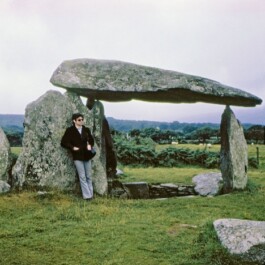
Robert Smithson Photographed by Nancy Holt at the Pentre Ifan Dolmen, dating 3,500 BCE, in Wales (1969).
Competition Finalist: 2016 MoMA PS1 Young Architects Program Competition (unbuilt)
Location: Museum of Modern Art and MoMA PS1
First Office Team: Anna Neimark, Andrew Atwood, Lily Nourmansouri, Alison Rust, Frank Yang
UC Berkeley Workshop: Julian Daly, Brooke Hair, Jeff Marsch, Edwin Obrien, Alex Spatzier
SCI-Arc Workshop: Deborah Garcia, Connor Gravelle, Daniel Hapton, Kyla Schaefer, Tidus Ta
Fabrication: Andrew Baccon, Machinemade, Erik Tietz, Machinemade
Structural Engineering: Matthew Melnyk, Nous Engineering
App Design: Theo Triantafyllidis

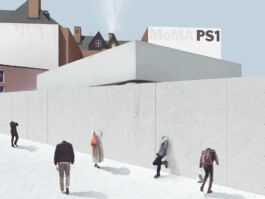
Dolmen outside MoMA PS1 musem's courtyard, rendering.


Dolmens Modeled in Paper, clockwise from top left: Dolmen de Vaour, France; Dolmen de Bagnol, Limousin, France; Dolmen at Gwangju, South Korea; Dolmen Bachwen, Gwynedd, Wales.
Dolmens Ordered by Leg Count.
Top Row, left to right: Dolmen de Vaour, France; Dolmen de Bagnol, Limousin, France; Dolmen Bachwen, Gwynedd, Wales.
Middle Row, left to right: Dolmen of Sindh, Pakistan; Dolmen at Gwangju, South Korea; Chokahatu Dolmen, India.
Bottom Row, left to right: Dolmen de la Piedra Gentil, Guatemala; Dolmen de Menga, Spain; Brownhill Dolmen in North Salem, New York, United States of America.
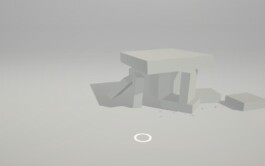
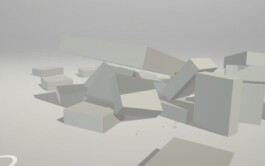
Theo Triantafyllidis in collaboration with First Office, MOMA PS1 #Dolmen app.
Dolmens are prehistoric monuments that we don’t know anything about. And we frankly don’t care; after all, we are not anthropologists. But because there are so many of them out there (dolmens that is, not anthropologists), and because they exist on nearly every continent, yet always manage to look somewhat alike, we thought that it would be appropriate to study them as they appear to us today: a bit crooked, half buried, and mostly broken.


Theo Triantafyllidis in collaboration with First Office, MOMA PS1 #Dolmen app, still shots.
We noted that their informal composition, built on asymmetrical parts that are deteriorating, often led to bad posture. Unlike some more canonical erect precedents, we thought that these things had character, like a dirty uncle or a stinky cheese. And after a not-so-thorough study of about twenty of them, we decided to do something that we were advised on numerous occasions against: a Dolmen for the courtyard of MoMA PS1 in Long Island City, New York.

MoMA PS1 Site Model with dolmen.

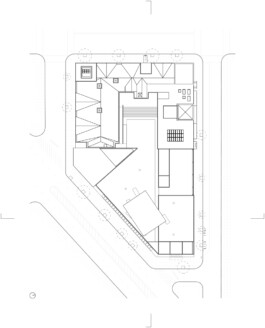
Site Plan at capstone level.
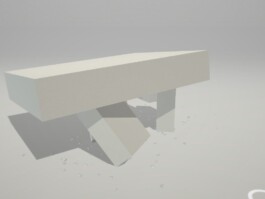
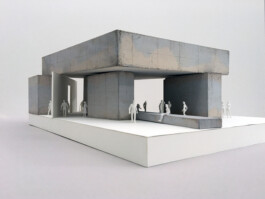
Too big to fit neatly within the courtyard’s bounding walls, too small to hover clearly above them, Dolmen PS1 seems a bit out of place. It’s off balance, for sure, gray and dull, nailed in place, with virtually only paint holding it together at the seams. The wooden capstone box seems to leak at the mere thought of rain.

Site Model Photograph.

Short Section through the site.

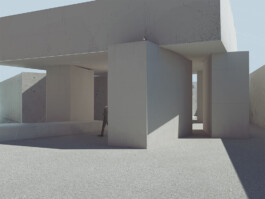
Dolmen inside MoMA PS1 museum's courtyard, rendering.


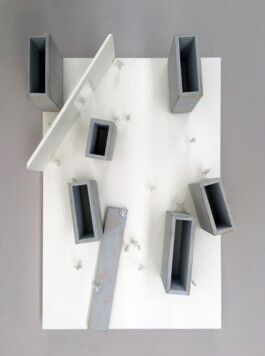
Model photograph at ground Level.
Plan at ground level.


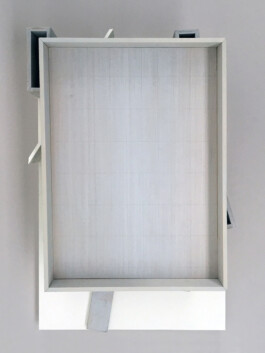
Plan at capstone level.
Model photograph at capstone level.

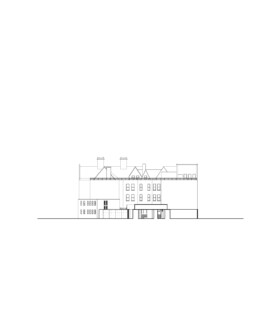
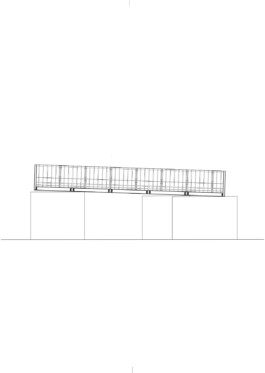
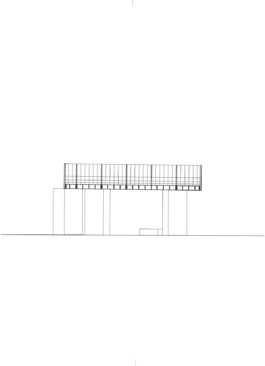
Long elevation.

Long section.

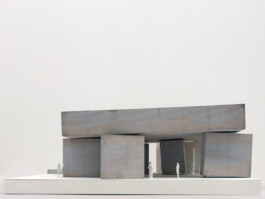
Model photograph, long elevation.


Model photograph in perspective.
Short section.
Maybe it is no place for a party. Everyone agreed. They shook their heads. There was an awkward silence.

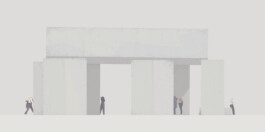
Short elevation with scale figures.

Dolmen PS1 model (Model Behavior exhibtion).


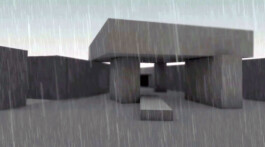
Rain animation stills.
Dolmen PS1

Robert Smithson Photographed by Nancy Holt at the Pentre Ifan Dolmen, dating 3,500 BCE, in Wales (1969).
Competition Finalist: 2016 MoMA PS1 Young Architects Program Competition (unbuilt)
Location: Museum of Modern Art and MoMA PS1
First Office Team: Anna Neimark, Andrew Atwood, Lily Nourmansouri, Alison Rust, Frank Yang
UC Berkeley Workshop: Julian Daly, Brooke Hair, Jeff Marsch, Edwin Obrien, Alex Spatzier
SCI-Arc Workshop: Deborah Garcia, Connor Gravelle, Daniel Hapton, Kyla Schaefer, Tidus Ta
Fabrication: Andrew Baccon, Machinemade, Erik Tietz, Machinemade
Structural Engineering: Matthew Melnyk, Nous Engineering
App Design: Theo Triantafyllidis

Dolmen outside MoMA PS1 musem's courtyard, rendering.

Dolmens Modeled in Paper, clockwise from top left: Dolmen de Vaour, France; Dolmen de Bagnol, Limousin, France; Dolmen at Gwangju, South Korea; Dolmen Bachwen, Gwynedd, Wales.

Dolmens Ordered by Leg Count.
Top Row, left to right: Dolmen de Vaour, France; Dolmen de Bagnol, Limousin, France; Dolmen Bachwen, Gwynedd, Wales.
Middle Row, left to right: Dolmen of Sindh, Pakistan; Dolmen at Gwangju, South Korea; Chokahatu Dolmen, India.
Bottom Row, left to right: Dolmen de la Piedra Gentil, Guatemala; Dolmen de Menga, Spain; Brownhill Dolmen in North Salem, New York, United States of America.
Theo Triantafyllidis in collaboration with First Office, MOMA PS1 #Dolmen app.
Dolmens are prehistoric monuments that we don’t know anything about. And we frankly don’t care; after all, we are not anthropologists. But because there are so many of them out there (dolmens that is, not anthropologists), and because they exist on nearly every continent, yet always manage to look somewhat alike, we thought that it would be appropriate to study them as they appear to us today: a bit crooked, half buried, and mostly broken.


Theo Triantafyllidis in collaboration with First Office, MOMA PS1 #Dolmen app, still shots.
We noted that their informal composition, built on asymmetrical parts that are deteriorating, often led to bad posture. Unlike some more canonical erect precedents, we thought that these things had character, like a dirty uncle or a stinky cheese. And after a not-so-thorough study of about twenty of them, we decided to do something that we were advised on numerous occasions against: a Dolmen for the courtyard of MoMA PS1 in Long Island City, New York.

MoMA PS1 Site Model with dolmen.

Site Plan at capstone level.
Too big to fit neatly within the courtyard’s bounding walls, too small to hover clearly above them, Dolmen PS1 seems a bit out of place. It’s off balance, for sure, gray and dull, nailed in place, with virtually only paint holding it together at the seams. The wooden capstone box seems to leak at the mere thought of rain.

Site Model Photograph.

Short Section through the site.

Dolmen inside MoMA PS1 museum's courtyard, rendering.

Model photograph at ground Level.

Plan at ground level.

Plan at capstone level.

Model photograph at capstone level.

Long elevation.

Long section.

Model photograph, long elevation.

Model photograph in perspective.

Short section.
Maybe it is no place for a party. Everyone agreed. They shook their heads. There was an awkward silence.

Short elevation with scale figures.


Rain animation stills.