Paranormal Panorama

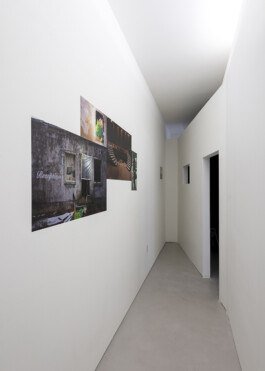
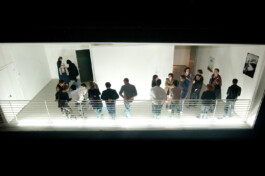
Paranormal Panorama, a temporary screening room at the Mackey Gallery, MAK Center for Art and Architecture, Los Angeles, California.
Year: 2013
Location: Mackey Gllery, MAK Center, Los Angeles, California
Collaborator: Constanze Ruhm, Film Director in Austria
Client: Kimberli Meier, MAK Center for Art and Architecture, Garage Vienna Exchange
First Office Team: Anna Neimark, Andrew Atwood, Mark Acciari, David Eskenazi, Ryan Roark
Contractor: Marcos Lozano Construction
Photography: Joshua White
This exhibition was made possible by the Austrian Federal Ministry for Education, Arts, and Culture.
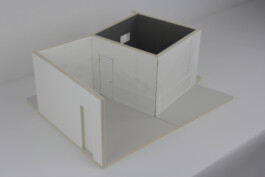
Paranormal Panorama is a temporary screening room built inside the Mackey Gallery. It divides a single room into three parts, each one containing a different rendering, an inside and an outside, a "mountain render" and a "room render." The model for the exhibition was built as a developed panorama of a mountain range, folded to conform to the proposed plan.

El Lissitzky, Proun Room, Berlin Art Exhibition (1923).
First Office, Paranormal Panorama, developed room model.


Mackey model, folded to conform to the composition of the plan.


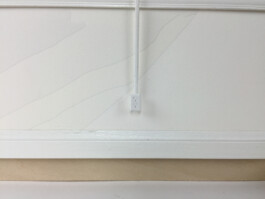
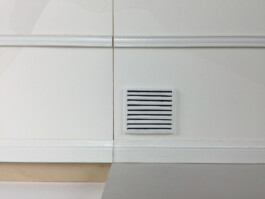
Model details showing electrical sockets, conduit, and air vents.
in 2013, some time in the middle of the summer in Los Angeles, a photograph was discovered of a home in Lausanne that belonged to the 19th century architect Viollet-le-Duc, its walls covered in a painted mural of a mountain range. Sent to Vienna, the image brought to mind a photograph of the Polish babysitter, Ewa, a character in Constanze Ruhm and Christine Lang’s film Kalte Probe [Cold Rehearsal], standing at Mont Tendre. This was a site of a tragic scene, where Ewa fell to her death in a crevasse while on a family outing along its glacier.


Agnieszka Wellenger as Ewa in Cold Rehearsal, dir. Constanze Ruhm & Christine Lang (2013).
Viollet le Duc, Door to salon at La Vedette, © Ministry of Culture France (ART528145).
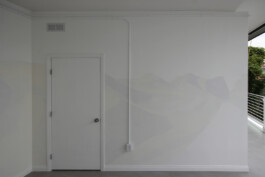
To commemorate the scene, a panoramic painting of Mont Tendre rendered the exterior walls of the screening room. Ordinary things, such as doors, molding, conduit, light switches, and vents, formed a continuous network of objects that populated the walls of the gallery. They were there, at times, merely for visual continuity. With these layers, both geographic and deomstic, Paranormal Panorama became a temporary interior built for viewing the film Cold Rehearsal.


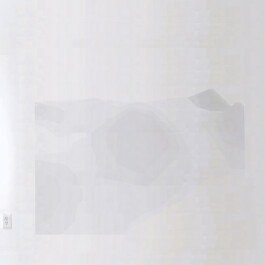
Above is the interior mural, rendered in dark green paint with shadows projected. Below is the exterior mural of Mont Tendre, rendered in white on white paints.


Exterior mountain panoramic render.
To build a material representation of the digitally rendered panorama, we looked toward another historical refrence, that of the The Cornell Box. In these 1980's experiments in computer graphics, scientists arranged a diptych model to study and compare the fidelity of computer generated renderings to photographs. In order to carry out the comparative experiments, researchers had to construct two Cornell Box models, a digital one (an image) and a plywood one (more like architecture). The digital model was rendered to simulate the diffuse light from a scene, while the plywood model was painted to closely resemble the impossibly diffuse “materials” of the digital model.


Cornell Box experiment (1984).
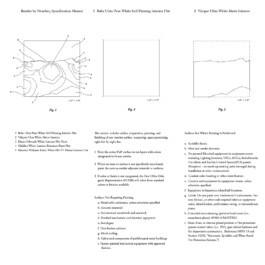
To translate a smooth gradient of a slit-scan into ordinary hues of house paint required a limited number of paints in the palette. We constrained the gradient to five tones, calling the new image a “render by number.” The width of masking tape and its straight edge became limiting factors for disciplining the digital image into a limited set of coordinates and outlines. Each masked layer was assigned a value of flat white interior base paint from a different manufacturer. It turned out that base whites from Sherwin Williams, Benjamin More, and Glidden, to name a few, when juxtaposed against one another on the wall, produced discrete differences in tone, hue, and reflectivity. They ranged from warm highlights to cool shadows, just different enough to make the painting visible.


Specifications for base white primers to render the mountain visible.


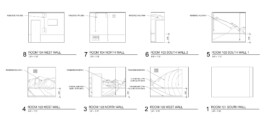
Interior elevations instruction set.


Paranormal Panorama, in collaboration with Constanze Ruhm. Photography Joshua White.


©White

©White
Paranormal Panorama

Paranormal Panorama, a temporary screening room at the Mackey Gallery, MAK Center for Art and Architecture, Los Angeles, California.
Year: 2013
Location: Mackey Gllery, MAK Center, Los Angeles, California
Collaborator: Constanze Ruhm, Film Director in Austria
Client: Kimberli Meier, MAK Center for Art and Architecture, Garage Vienna Exchange
First Office Team: Anna Neimark, Andrew Atwood, Mark Acciari, David Eskenazi, Ryan Roark
Contractor: Marcos Lozano Construction
Photography: Joshua White
This exhibition was made possible by the Austrian Federal Ministry for Education, Arts, and Culture.
Paranormal Panorama is a temporary screening room built inside the Mackey Gallery. It divides a single room into three parts, each one containing a different rendering, an inside and an outside, a "mountain render" and a "room render." The model for the exhibition was built as a developed panorama of a mountain range, folded to conform to the proposed plan.

El Lissitzky, Proun Room, Berlin Art Exhibition (1923).
First Office, Paranormal Panorama, developed room model.


Mackey model, folded to conform to the composition of the plan.


Model details showing electrical sockets, conduit, and air vents.
in 2013, some time in the middle of the summer in Los Angeles, a photograph was discovered of a home in Lausanne that belonged to the 19th century architect Viollet-le-Duc, its walls covered in a painted mural of a mountain range. Sent to Vienna, the image brought to mind a photograph of the Polish babysitter, Ewa, a character in Constanze Ruhm and Christine Lang’s film Kalte Probe [Cold Rehearsal], standing at Mont Tendre. This was a site of a tragic scene, where Ewa fell to her death in a crevasse while on a family outing along its glacier.

Viollet le Duc, Door to salon at La Vedette, © Ministry of Culture France (ART528145).

Agnieszka Wellenger as Ewa in Cold Rehearsal, dir. Constanze Ruhm & Christine Lang (2013).
To commemorate the scene, a panoramic painting of Mont Tendre rendered the exterior walls of the screening room. Ordinary things, such as doors, molding, conduit, light switches, and vents, formed a continuous network of objects that populated the walls of the gallery. They were there, at times, merely for visual continuity. With these layers, both geographic and deomstic, Paranormal Panorama became a temporary interior built for viewing the film Cold Rehearsal.


Above is the interior mural, rendered in dark green paint with shadows projected. Below is the exterior mural of Mont Tendre, rendered in white on white paints.


Exterior mountain panoramic render.
To build a material representation of the digitally rendered panorama, we looked toward another historical refrence, that of the The Cornell Box. In these 1980's experiments in computer graphics, scientists arranged a diptych model to study and compare the fidelity of computer generated renderings to photographs. In order to carry out the comparative experiments, researchers had to construct two Cornell Box models, a digital one (an image) and a plywood one (more like architecture). The digital model was rendered to simulate the diffuse light from a scene, while the plywood model was painted to closely resemble the impossibly diffuse “materials” of the digital model.


Cornell Box experiment (1984).
To translate a smooth gradient of a slit-scan into ordinary hues of house paint required a limited number of paints in the palette. We constrained the gradient to five tones, calling the new image a “render by number.” The width of masking tape and its straight edge became limiting factors for disciplining the digital image into a limited set of coordinates and outlines. Each masked layer was assigned a value of flat white interior base paint from a different manufacturer. It turned out that base whites from Sherwin Williams, Benjamin More, and Glidden, to name a few, when juxtaposed against one another on the wall, produced discrete differences in tone, hue, and reflectivity. They ranged from warm highlights to cool shadows, just different enough to make the painting visible.


Specifications for base white primers to render the mountain visible.


Interior elevations instruction set.


Paranormal Panorama, in collaboration with Constanze Ruhm. Photography Joshua White.


©White

©White