Shotgun House

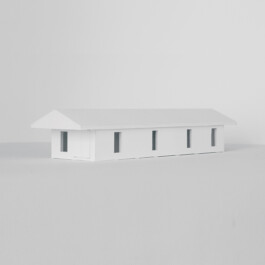
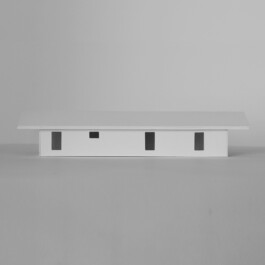
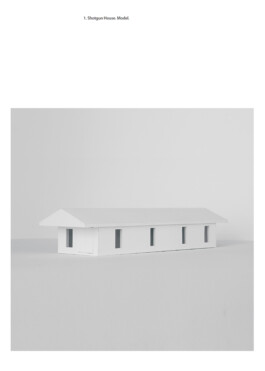
Shotgun House, Model
Location (Unbuilt: Lexington, KY)
Competition Luigart Makers Spaces York Street Challenge Finalist
Exhibition Treatise: Why Write Alone? Madlener House, Graham Foundation, Chicago, Illinois: January 23–March 28, 2015, curated by Jimenez Lai
Construction Chicago Biennial at 6018 North: October 3-January 3, 2016
First Office Team
Andrew Atwood
Anna Neimark
David Eskenazi
Melissa Lee
Brooke Hair
Alex Spatzier
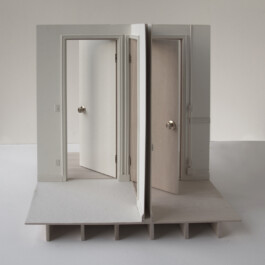
Duchamp Doors, Model
An art gallery and a domestic interior seem, at first, in direct conflict with one another. The former is usually public, modern and empty; the latter – more often private, vernacular and full of stuff. But upon a closer look at the typical architectural layouts of these plans, we realized that the two programs share one common principle. Both are composed of rooms in enfilade. There are no hallways as one moves through one room to the next and the next in either case.

Model’s Interior
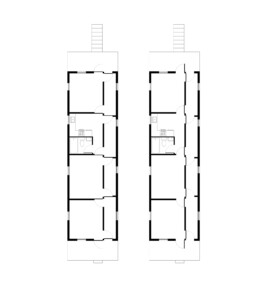
Our proposal takes advantage of this formal similarity. The Shotgun House and the Art Gallery coexist and reinforce one another. They share the enfilade plan, so it can be programmed according to the artist’s and the family’s needs. The home and the gallery open into one another to produce a continuous interior of rooms. But in an extreme case, they can also be locked off from one another and occupied simultaneously and independently. Both have their own front doors and linear circulation paths

Shotgun House, Axonometric
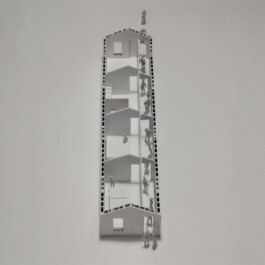
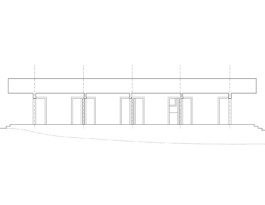
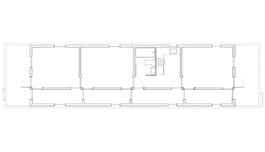
To construct the typical shotgun plan and gallery at the same time, the house is gutted and rebuilt with four internal walls. The three transverse walls divide the length of the interior into four equal parts: the workshop, bedroom, wet room, and community room from front to back. The longitudinal wall splits each room into two unequal parts: the large domestic programs on the South-Eastern side, and a long skinny gallery along the North-Western wall. A total of eight rooms are thus produced, not counting the bathroom, and each one is connected to all of its neighbors.

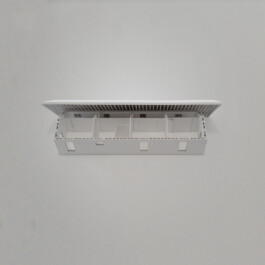
Roof Cracked Open

Diagrammatic Plans: Closed House / Open House

Shotgun House, Model in Elevation

Shotgun House, Long Section

Shotgun House, Plan
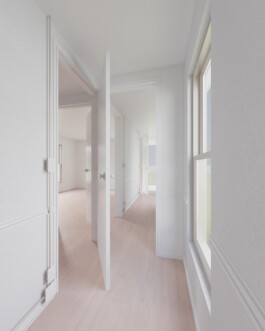
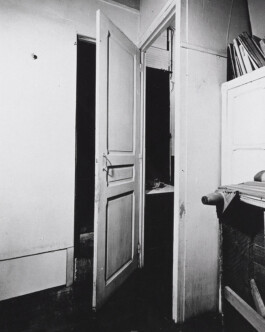
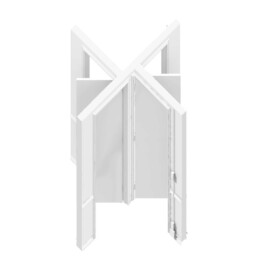
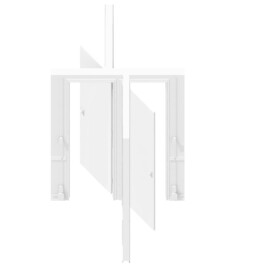
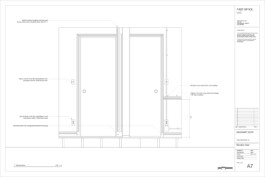
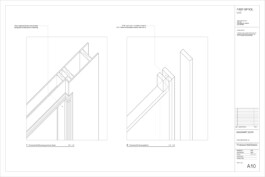
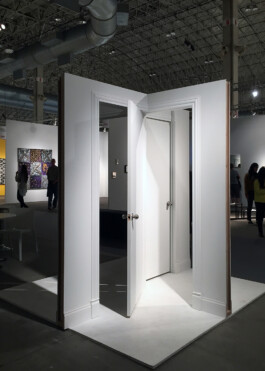
As a result, every room has four openings, four paths of moving in and out of it. And in a typical gallery or museum layout, these openings would be left always open. They would be empty cuts in the wall. But because this is a house, and because a house requires private and separate spaces, or else it begins to be called a loft, our entry ways are designed to have doors. Now if we filled every opening with a door, there would be twenty doors in this one little house. It would be absurd! Instead, every door spans between two door frames. As a door opens one room, it simultaneously and inadvertently closes another. There is a precedent for this double-door in a ready-made built by a carpenter according to instructions laid out by Marcel Duchamp in 1927. We adopted the same basic element and designed its structural and ornamental details to fit the standard parts of Shotgun House construction and decoration easily found in a Home Depot. These include standard 2x4 studs, door frames, baseboard, chair rail, and crown molding.


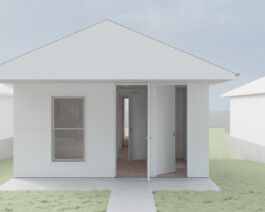
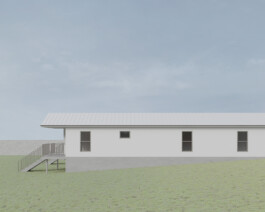
Front of House, Rendering
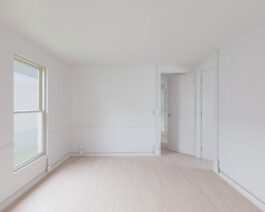
Room Interior, Rendering
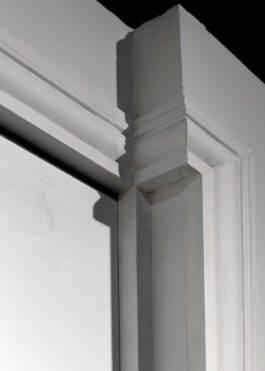
Typically called molding, these elements are not just decorative they are also, of course, practical. They help span the gaps and bridge expansion joints necessary in typical light frame construction. The doorjamb detail is one place where the elastic qualities and flexible nature of domestic molding is of great benefit. The molding wraps the corner of the jamb and also folds in the corner of the room, making the double-door detail possible.

Corridor interior, Rendering

Photograph of the Door in the 11, rue Larrey apartment (Paris, 1927), Schwarz Gallery ed., 1963. Marcel Duchamp Exhibitions records, Philadelphia Museum of Art, Library & Archives © Association Marcel Duchamp / ADAGP, Paris / Artists Rights Society (ARS), New York 2024
Beyond the details of the walls and the doors, we left the house plan blank whenever possible to provide for full flexibility. If you ask us, the perfect maker space is a white room with lots of electrical outlets. Someone may disagree about the color and decide to paint the room off-white. Paint is cheap and flexible. To create the same level of flexibility for the configuration of electrical outlets, we mounted the electrical conduit directly on the outside surfaces of the walls as opposed to burying them deep inside the walls. The building’s electrical infrastructure is not seen as something that is fixed. It does not govern the nature of the spaces. It does not limit the possibilities for the room. Instead, like color, the electrical configuration of the house can be altered and specified by a quick trip to a local hardware store. Surface mounted outlets and exposed conduit are not only practical and flexible, they are also beautiful. Like molding, they add lines and texture to the walls using the most mundane elements of a typical interior.

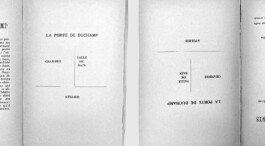
Jean van Heeckeren and Jacques-Henry Lévesque, “La porte de Duchamp,” Orbes 2ème série n°2 (Paris: Au Sans Pareil, Summer 1933)
On the exterior of the house, we have preserved its identity while reusing and maintaining as much of the original house as possible. For environmental purposes, we have upgraded the windows and replaced the wall insulation, increasing the building’s thermal performance. The roof in the front and back has been extended to provide extended shading in the summer months while allowing heat and light to enter in the winter months. Perhaps the strangest part of it all is that now the house has two fronts: two porches, each with two front doors. The Shotgun House remains contextual and preserved, and at the same time opens to a new possibility of art to produce a truly public and open realm within.


Duchamp Doors, Oblique Renderings

Duchamp Doors, Model 1” = 1’ scale


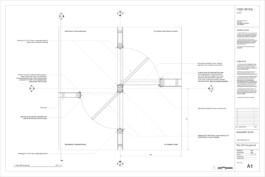
Construction Drawings for the 2016 Chicago Art Expo


Doorstop
Doors Built by 6018 North. Photography Carolina Murcia

Shotgun House, Backside Rendering

Site: Mr. Wren
First Office was founded in 2011 by Anna Neimark and Andrew Atwood to create a dialog between architectural practice and academic discourse. Their collaborative work spans buildings, exhibitions, and publications, all rooted in the belief that architecture is a form of cultural production.
The practice has engaged with leading institutions, including the MAK Center for Art and Architecture, the Chicago and Venice Biennials, MoMA PS1’s Young Architects Program, and the Architectural League of New York. The projects and essays of First Office have been recognized with awards and compiled in Nine Essays (Treatise Press, 2015), as well as in Andrew’s publication Not Interesting: On the Limits of Criticism in Architecture (Applied Research and Design, 2017).
Anna Neimark
Design Faculty and Visual Studies Coordinator, SCI-Arc
anna.neimark@gmail.com
Andrew Atwood
Licensed Architect and Associate Professor, UC Berkeley
w.andrew.atwood@gmail.com